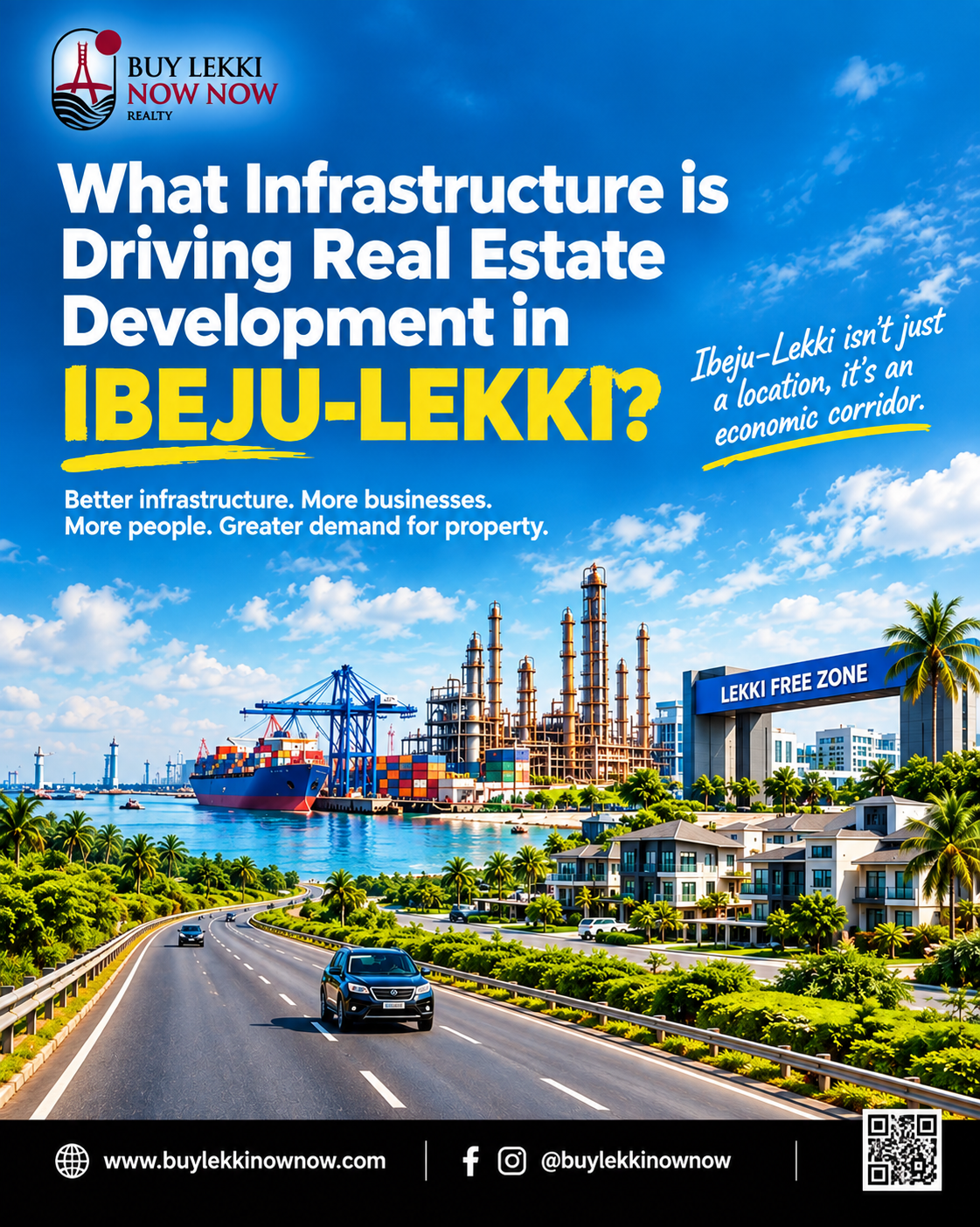
WHAT INFRASTRUCTURE IS DRIVING REAL ESTATE DEVELOPMENT IN IBEJU-LEKKI?
Ibeju-Lekki infrastructure is no longer just about roads.
Something bigger is happening.
When a place gets better roads, ports, industrial facilities, logistics networks, jobs and housing, something predictable begins to happen:
People and businesses start moving closer.
And when people move closer, they need land, houses, shops, warehouses, offices, hotels and other forms of real estate.
That is the story behind the growing Ibeju-Lekki development corridor.
But what exactly is driving it?
Let’s break it down. 👇🏽
---
1️⃣ ROADS: THE FIRST THING THAT CHANGES A LOCATION
Real estate needs accessibility.
A piece of land can be cheap because getting there is difficult. But once major roads improve connectivity to an area, the calculation begins to change.
The Lekki-Epe corridor is strategically important because it connects residential communities with the growing industrial and logistics ecosystem around the Lekki Free Zone.
The Nigerian Ports Authority has also identified improved hinterland access around the Epe region as an important part of the wider port infrastructure.
And this is where the real estate connection becomes interesting:
Better accessibility → easier movement → more business activity → more people → more demand for property.
---
2️⃣ THE LEKKI DEEP SEA PORT: TRADE CREATES PROPERTY DEMAND
A port is not just somewhere ships come and go.
A functioning port creates an entire ecosystem around it.
Think:
🚢 Shipping companies
🚛 Haulage and logistics
📦 Warehousing
🏢 Offices
🏪 Businesses
👷 Workers
🏠 Housing
🍽️ Hospitality
⛽ Support services
The Lekki Deep Sea Port has already moved beyond the construction-stage story into commercial operations, and the Nigerian Ports Authority says its infrastructure supports large vessels and growing transshipment activity.
That matters for real estate because economic activity needs physical space.
A logistics company needs a warehouse.
A worker needs accommodation.
A business needs an office.
A growing population needs shops, schools, healthcare and other services.
And all of these require real estate.
---
3️⃣ DANGOTE REFINERY: AN INDUSTRIAL ANCHOR
Then you have one of the biggest industrial developments in the corridor:
Dangote Petroleum Refinery & Petrochemicals.
The facility is located in the Lekki Free Zone and currently has a stated crude distillation capacity of 700,000 barrels per day, with infrastructure including storage, pipelines, a 3km deepwater jetty, truck-loading facilities and dedicated power.
But don't look at the refinery as just one factory.
Look at the ecosystem around the factory.
Suppliers.
Contractors.
Logistics companies.
Distributors.
Employees.
Service providers.
Small businesses.
Accommodation.
Food businesses.
Transportation.
When a major industrial project establishes itself somewhere, it can create additional economic activity around it.
And economic activity creates property demand.
---
4️⃣ THE LEKKI FREE ZONE: INDUSTRY NEEDS REAL ESTATE
This may be one of the most important pieces of the puzzle.
Industrial development doesn't happen in isolation.
Businesses entering a free zone require:
Industrial land
Warehouses
Offices
Staff accommodation
Logistics facilities
Retail services
Hospitality
Supporting infrastructure
The Dangote Industries Free Zone alone covers a very large industrial footprint within the Lekki Free Zone, alongside major refinery, fertilizer and petrochemical operations.
So the question isn't simply:
"What is being built?"
The better question is:
"What businesses and people will need to exist around what is being built?"
That second question is where real estate opportunities become easier to understand.
---
5️⃣ LOGISTICS: FOLLOW THE MOVEMENT OF GOODS
Here's another factor people sometimes overlook.
Where goods move, businesses follow.
Ports bring cargo.
Factories produce goods.
Trucks move them.
Warehouses store them.
Distributors move them again.
That creates demand for logistics infrastructure.
And logistics infrastructure requires land.
This is why industrial and logistics development can have a ripple effect on surrounding property demand.
One major project can create several secondary businesses.
And those businesses need somewhere to operate.
---
6️⃣ ALARO CITY: BUILDING AN ECONOMIC COMMUNITY
Another development within the broader Lekki Free Zone ecosystem is Alaro City.
Its developers describe it as a mixed-use development providing infrastructure such as roads, power, water, ICT and waste management for businesses, homes, schools, healthcare and other uses. They also state that more than 100 businesses are already located there.
That is significant because real estate development becomes stronger when residential, commercial and industrial activities grow together.
People don't just need somewhere to sleep.
They need somewhere to:
Work. Shop. Eat. Relax. Learn. Do business.
That's how an area gradually develops into an economic ecosystem rather than simply a collection of houses.
---
7️⃣ HOUSING: WHEN JOBS MOVE, PEOPLE MOVE
Here's the simplest way to understand the relationship:
Jobs attract people.
People create housing demand.
Housing demand creates development.
The Federal Government's Renewed Hope City project in Ibeju-Lekki is another example of large-scale housing development in the corridor, with 2,084 housing units reported as part of the project in 2026.
As economic activity expands, the demand isn't necessarily limited to luxury homes.
There can be demand for:
🏠 Affordable housing
🏘️ Rental apartments
🏡 Family homes
🏢 Serviced apartments
🏨 Hotels
🛍️ Neighbourhood retail
🏭 Industrial property
Different income groups create different property markets.
---
SO WHAT DOES ALL THIS MEAN FOR REAL ESTATE?
This is the part investors should pay attention to.
Real estate development doesn't happen simply because someone builds houses.
It happens because demand begins to form.
And demand can be driven by:
Infrastructure → Businesses → Jobs → Population → Housing → Services → More businesses.
That is the cycle.
And Ibeju-Lekki is increasingly being shaped by several of these forces at the same time.
But there's an important lesson:
Don't buy land simply because someone says "Ibeju-Lekki is developing."
Ask better questions.
Where exactly is the property?
What infrastructure is actually nearby?
What roads provide access?
What economic activity is happening around it?
What is the title?
What is the current demand?
Who is likely to occupy or buy there in the future?
Because being in Ibeju-Lekki and being well-positioned within Ibeju-Lekki are not necessarily the same thing.
---
THE BIGGER PICTURE
The most interesting thing about Ibeju-Lekki development may not be any single project.
It is the combination.
🚧 Roads improving connectivity.
⚓ Port infrastructure facilitating trade.
🏭 Industrial projects creating economic activity.
🚛 Logistics moving goods.
🏢 Businesses establishing operations.
🏠 Housing accommodating workers and residents.
🛍️ Commercial businesses following the population.
And when these things begin reinforcing one another, a location can gradually transition from "future potential" to "active economic corridor."
That is why, when studying real estate, don't just look at what is there today.
Look at the infrastructure, businesses, jobs and movement that are shaping what could be there tomorrow.
Because sometimes, the most important thing about a piece of land isn't what is sitting on it today.
It's what is being built around it.
---
If you’re looking for a property in Ibeju-Lekki, Shalom Tech City 2.0 is currently selling for ₦9 million.
Strategically located close to the expressway, with easy access to key infrastructures and landmarks like:
• HFP Paving Stone
• Pan-Atlantic University
• Growing residential and commercial hubs.
 Back
Back